
Interview with Oriana Bernasconi, Director of Data Justa
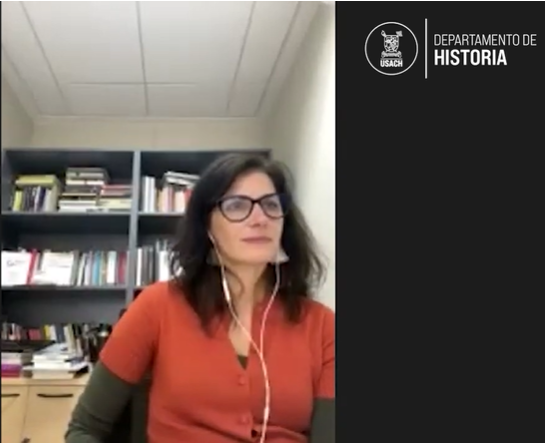
Within the framework of the series of interviews carried out by the Chair of Human Rights of the Department of History of the University of Santiago de Chile (USACH), Oriana Bernasconi, director of the Millennium Nucleus Data Justa and academic at Instituto de Éticas Aplicadas de la Pontificia Universidad Católica de Chile, she reflected on the processes of documenting and recording human rights violations in Chile. Her analysis covered both the period of the dictatorship and the current situation, highlighting the importance of studying how the State produces and uses knowledge about victims of serious violations.
Drawing on her experience during the dictatorship, Bernasconi emphasized the role of civil society organizations such as the Committee for Cooperation for Peace in Chile (1973-1975) and the Vicariate of Solidarity (1976-1992), which played a crucial role in documenting human rights violations during that period. According to the director of Data Justa, these archives not only made it possible to learn about the atrocities committed early on, but also to advance legal proceedings, truth commissions, and various civil society initiatives focused on memory and guarantees of non-repetition. In this sense, the records were not limited to their legal value, but also laid the foundation for a humanitarian language and a documentary tradition that continues to this day.
The researcher also recalled lessons learned from previous projects, such as «Tecnologías Políticas de la Memoria: Una genealogía de los dispositivos de registro y denuncia de las violaciones a los derechos humanos por la dictadura militar en Chile (1973-2013)» or the Anillos research project «Tecnologías Políticas de la Memoria: Usos y apropiaciones contemporáneas de dispositivos de registro de pasadas violaciones a los derechos humanos en Chile»where the need for an interdisciplinary approach in this field became evident, integrating sociology, history, archival science, psychology, anthropology, and law. This perspective is what underpins the work of the Millennium Nucleus for Data Justa, aimed at understanding how the State produces, manages and uses data on human rights violations, particularly around three victimizing events: femicide, human trafficking and institutional violence in the context of the social uprising.
Finally, Bernasconi argued that, more than fifty years after the coup, archives should be understood not only as traces of the past, but also as living tools to contest memories, produce knowledge, demand accountability in the present, and contribute to the strengthening of democracy.
We invite you to watch the full interview on the YouTube channel of the Department of History at USACH and to read the boletín «La democracia bajo ataque«.