
By: Oriana Bernasconi, Daniela Accatino, Jacqueline Vega and Daniela Mansilla
Of the total number of institutional violence offenses, only a very small proportion (6.7%) involved identified defendants. Of these cases, only about one quarter resulted in convictions (14.3%) or acquittals (11.3%). Provisional closure or the decision not to proceed was applied in more than 50% of the cases.
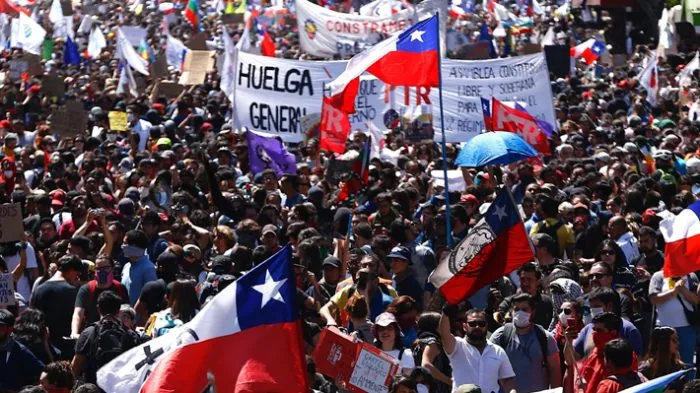
El Mostrador_18 de octubre 2025_Six years after Chile’s social uprising, the Public Prosecutor’s Office published a report providing relevant data on institutional violence and offenses related to these events. Between October 18, 2019, and March 31, 2020, 32,901 cases associated with the social uprising were filed with the Prosecutor’s Office, involving one or more offenses. According to the institution’s classification, of the 35,146 offenses identified, 12,002 correspond to institutional violence — that is, violence perpetrated by members of the Armed Forces and law enforcement agencies against civilians; 11,156 to property crimes and looting; 7,965 to public disorder and other offenses; 3,293 to offenses involving mistreatment of state agents; and 732 to arson offenses.
Institutional violence affected more than 11,000 victims, mainly through unlawful coercion or ill-treatment (70.4%), abuses against civilians (20%), torture (1.8%), and injuries of varying severity (3.3%). Of the total number of institutional violence offenses, only a very small proportion (6.7%) involved identified defendants. Of these cases, only about one quarter resulted in convictions (14.3%) or acquittals (11.3%). The use of provisional closure or decisions not to proceed in more than 50% of cases points to a significant gap in the pursuit of justice.
The report published by the Public Prosecutor’s Office offers an opportunity to reflect on the role of records and data in the justice system, as well as on the ethical, technical, and political issues involved in the production and circulation of information from a data justice perspective, particularly when human rights violations committed by state agents are at stake.
In the field of human rights, data justice is an approach that calls for achieving — or striving to achieve — epistemic justice, and understands the production and use of data as serving restorative knowledge. In other words, data justice recognizes the dignity of every human being and seeks to ensure that documentation is produced without bias or stereotypes, and without naturalizing the phenomena being reported. It is also an approach that places data at the service of rights restitution, reparation for affected individuals, and the transformation of the conditions that give rise to violence.
In 2023, the Report of Proposals and Recommendations issued by the Comprehensive Reparations Roundtable for people affected during the social uprising, established by the Ministry of Justice and Human Rights, warned of the gaps between the available figures and the difficulty of determining the number of victims of human rights violations in this context. These differences were not only quantitative, but also conceptual, resulting from the categories used by the various institutions involved. The legal impossibility of exchanging personal data between state agencies has had, and continues to have, significant consequences for comprehensive and timely assistance, by shifting the responsibility for transferring records and data onto the victims themselves, thereby increasing the risk of revictimization.
The Prosecutor’s Office report represents an exercise in accountability regarding investigations within the criminal justice system — one that should become a regular practice in public administration, as part of the ongoing provision of information to the public. Providing this information is especially important when dealing with events whose interpretation remains contested.
The report recognizes the importance of coordination among civil society organizations, health centers, and different public institutions in recording initial information and channeling complaints, as well as the relevance of tools — such as the “Institutional Violence Background Form” — developed for that purpose. Attention to these practices appears to be key to analyzing the causes of the justice gaps identified above.
This report illustrates the need to understand data not only as technical inputs, but as tools for justice, reparation, and public memory. The protection and progressive advancement of human rights also require data production systems that are interoperable, accessible, accurate, and capable of supporting actions in favor of affected individuals. Building and maintaining records of human rights violations is a practice of justice. To record is to recognize, to assign value, to assume responsibility, to produce and safeguard evidence, and to diagnose harm. It is therefore a condition for the full realization of timely justice.