
Two chapters in the 2026 Annual Report on Human Rights in Chile examine what happens when rights recognised in laws and regulations do not translate into timely, continuous and comprehensive responses. Researchers from Data Justa Lidia Casas, Elizabeth Lira and Daniela Mansilla contributed to these studies.
How can we determine whether the State is fulfilling its human rights obligations? The existence of laws, programmes and technical guidelines is an important step, but it is not enough to answer this question. We must also examine what happens when people attempt to exercise their rights, the responses they receive and the information available to assess the results.
This concern runs through two chapters of the 2026 Annual Report on Human Rights in Chile involving members of Data Justa. The first analyses access to healthcare for trans and gender-diverse people. The second examines the healthcare provided to those injured during the 2019 social uprising and the remaining challenges involved in moving towards comprehensive reparation.
Although the chapters address different populations and problems, both reveal a gap between the formal recognition of rights and their implementation. They also identify a common challenge: without sufficient, up-to-date and reliable information, it is difficult to identify needs, guide public policy and demand accountability for its outcomes.
Access to healthcare cannot be guaranteed by regulations alone
The chapter Health of Trans and Gender-Diverse People from the Perspective of International Human Rights Law was written by Lidia Casas Becerra, a Data Justa researcher and director of the UDP Human Rights Centre, together with Laura Dragnic Tohá, María Belén Saavedra Prats and Mercedes Carrasco-Portiño.
The study acknowledges the progress made over the past decade in the legal recognition of gender identity, respectful treatment and the creation of specialised programmes. However, it warns that considerable gaps remain between what regulations establish and the experiences of those seeking healthcare.
The difficulties identified include the unequal territorial distribution of specialised services, a shortage of professionals in areas such as endocrinology and plastic and reconstructive surgery, waiting lists, interruptions in some treatments and differences among health services.
The study also finds that staff training remains insufficient. Although healthcare workers may be willing to provide respectful care, the lack of technical knowledge, training and protocols means that such treatment may depend on the initiative of individual teams rather than on an institutional policy.
The chapter analyses these conditions through four components of the right to health: availability, accessibility, acceptability and quality. From this perspective, the formal existence of a healthcare service is not enough. It must also be available and accessible without discrimination, respect people’s identity and confidentiality, and be provided by properly trained teams.
The chapter also warns of the uncertainty that can result from administrative, budgetary or regulatory decisions. The risk is not limited to the explicit elimination of a right. It may also arise when teams are reduced, programmes are interrupted or access to an established service becomes progressively more difficult.
The authors therefore recommend strengthening the regulatory framework, ensuring continuity of care, introducing mandatory staff training, reinforcing oversight and creating permanent mechanisms through which organisations of trans and gender-diverse people can participate in the development and evaluation of health policies.
Healthcare is part of reparation, but it cannot replace it
The chapter Social Uprising, Health and Reparation for Victims of Human Rights Violations: An Unresolved Discussionwritten by Elizabeth Lira Kornfeld, deputy director of Data Justa, and Daniela Mansilla Santelices, the Centre’s research coordinator, analyses the healthcare response provided to people injured during the social uprising.
The study acknowledges the importance of the measures adopted by the Ministry of Health. The initial emergency response, which focused on eye injuries, developed into a more comprehensive system that expanded its services and subsequently included people who still had pellets lodged in their bodies.
The Comprehensive Eye Injury Reparation Programme, created in 2019, was reformulated in 2022 as the Support and Care Plan for Victims of Ocular Trauma. This process enabled the development of specific capacities for treatment and rehabilitation. However, the interventions remained largely confined to the healthcare sector and did not become part of a comprehensive reparation policy.
This distinction matters. Medical and psychological care can contribute to reparation, but it cannot by itself address all the consequences of a human rights violation. A comprehensive response must also coordinate legal, social, economic and symbolic measures, while considering the changing needs of victims and their families over time.
The chapter notes that the Ministry of Health recorded 13,046 emergency consultations associated with the social uprising. However, this figure does not reveal how many people were victims of institutional violence or the different violations they experienced.
Subsequent initiatives also failed to consolidate a unified, inter-institutional register. This limits the State’s ability to monitor cases, coordinate public responses and assess how victims’ needs evolve, particularly for those with permanent injuries or those who were children or adolescents when they were injured.
Among their recommendations, the authors propose implementing a national comprehensive reparation policy, creating a unified register that protects personal data, strengthening the coverage and continuity of the Support and Care Plan, and coordinating healthcare with justice, education, employment and social protection services.
The chapter also highlights the need to train those who work with victims of violence and to establish care policies for professional teams. Sustaining a specialised response requires protecting institutional capacities and preventing occupational burnout and vicarious trauma.
What the State fails to record also has consequences
The Report’s introduction identifies the lack of information as a recurring problem in different areas. If the State does not know who requires assistance, what barriers they face or what results its programmes produce, it cannot determine whether it is fulfilling its obligations.
This issue appears in different ways in the two chapters. In healthcare for trans and gender-diverse people, limited public information makes it difficult to compare territories, identify the services available and monitor their quality. In the case of the social uprising, the absence of a consolidated register prevents the State from determining the total number of victims and organising a comprehensive response.
Producing information is not merely an administrative task. Data can make needs visible, guide the distribution of resources, facilitate coordination between institutions and enable the evaluation of public decisions. At the same time, the collection and use of such information must protect people’s privacy and confidentiality.
The challenge, therefore, is not simply to collect more data. It also involves deciding what information is needed, how it should be organised, who may access it and how it will be used to guarantee rights.
Human rights as a standard for evaluating State action
The 2026 Annual Report on Human Rights in Chile is the twenty-fourth edition produced by the Human Rights Centre at Diego Portales University. Its eight chapters examine the Chilean State’s fulfilment of its obligations in areas including childhood, housing, education, labour justice, freedom of the press and health.
This edition proposes a “return to basics”: understanding human rights as enforceable obligations, limits on the exercise of power and standards for evaluating both the objectives pursued by the State and the means it uses to achieve them.
From this perspective, the two chapters involving members of Data Justa do more than describe programmes or list available services. Both ask whether existing responses allow people to exercise their rights effectively, whether they can be sustained over time and whether the State has enough information to identify and correct shortcomings.
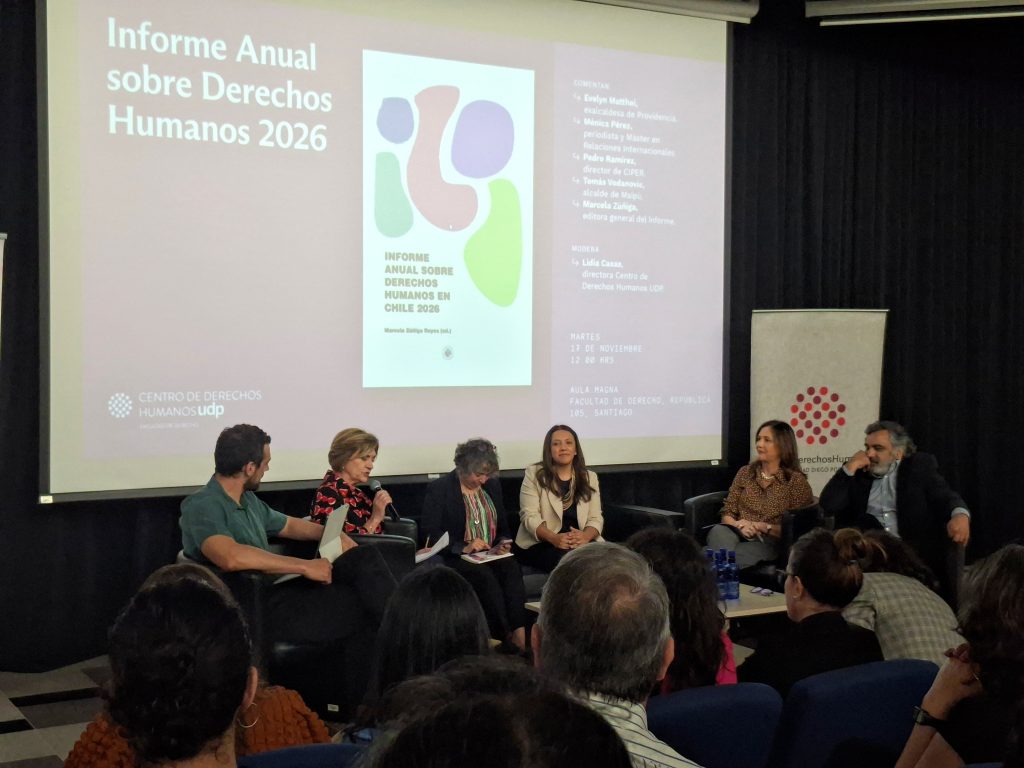
The Report was launched on 17 November at the Faculty of Law of Diego Portales University. The event included a presentation by Marcela Zúñiga, the Report’s general editor, and comments from Evelyn Matthei, former mayor of Providencia; Mónica Pérez, journalist and holder of a master’s degree in International Relations; Pedro Ramírez, director of CIPER; and Tomás Vodanovic, mayor of Maipú. The discussion was moderated by Lidia Casas, director of the UDP Human Rights Centre and a Data Justa researcher.
To watch the launch of the 2026 Annual Report on Human Rights in Chile, click here.
To download the full Report or read its individual chapters, click here.