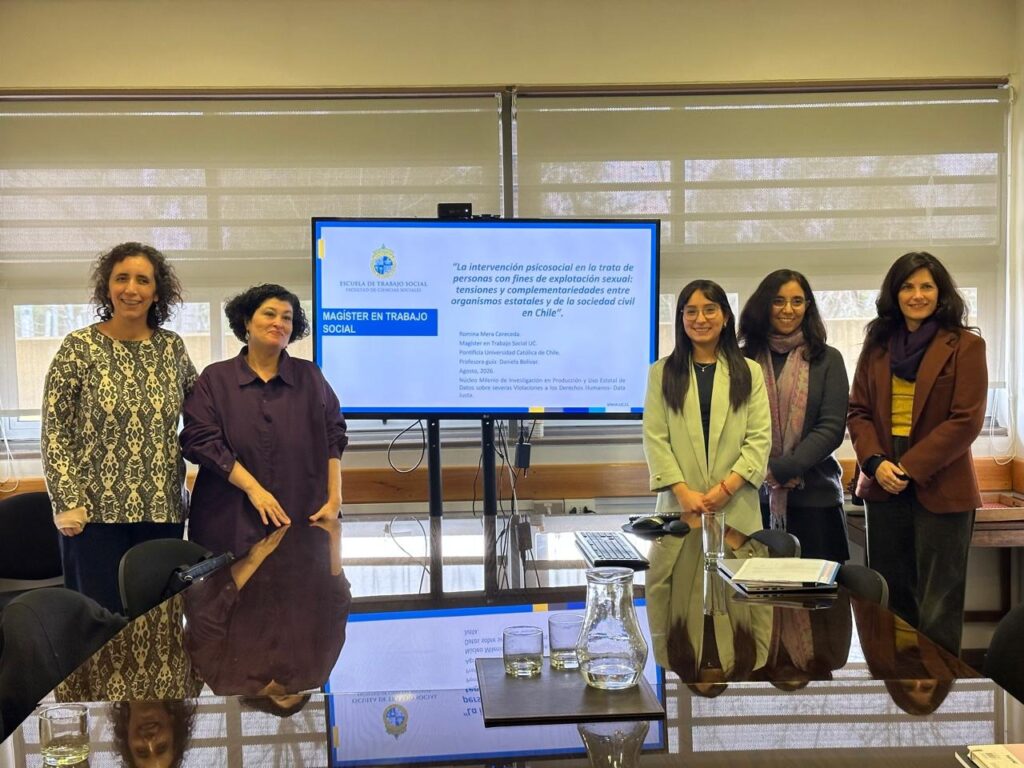
Romina Mera completes her master’s thesis on psychosocial intervention in human trafficking
Recognizing oneself as a victim of human trafficking can take time. For this reason, psychosocial intervention is not simply about providing services or following a procedure: it also involves supporting recovery processes that unfold at different paces and involve different needs.
This is one of the main findings of Romina Mera's thesis.On Thursday, August 27, she defended her research to obtain a Master’s degree in Social Work from Pontificia Universidad Católica de Chile. With this milestone, she became the second master’s student affiliated with Data Justa to complete her degree.
Her thesis, entitled “Psychosocial Intervention in Human Trafficking for the Purpose of Sexual Exploitation: Tensions and Complementarities between State Agencies and Civil Society Organizations in Chile,”examined how professionals from state institutions and civil society organizations understand and provide support to victims.
The research shows that there is no single way to intervene. Experiences of exploitation, individual needs, and recovery timelines differ from one person to another. Effective intervention therefore requires flexibility, continuity, and attention to each person’s particular trajectory.
“Part of psychosocial intervention involves supporting women through the process of recognizing themselves as victims of harm,” explains Oriana Bernasconi, Director of Data Justa and a member of the thesis evaluation committee. “Intervention consists precisely in accompanying this process of recognition and helping women move forward in developing their autonomy.”
State institutions and civil society play different roles
The thesis also identifies differences between the work carried out by state agencies and civil society organizations.
Public institutions operate within defined mandates, procedures, and administrative frameworks. Civil society organizations, by contrast, often have greater flexibility to respond to needs that extend beyond the institutional services currently available.
These approaches can complement one another, but coordination difficulties can affect the continuity of support. For survivors, this may result in interruptions, fragmented responses, or the need to turn to multiple institutions to obtain assistance.
“The research proposes understanding psychosocial intervention as part of a comprehensive response, in which different dimensions and actors come together to address the complexity of the phenomenon,” Romina explains.
From this perspective, responding to human trafficking requires looking beyond the work of any single institution. It also requires strengthening coordination among those involved in providing support and building responses that can be sustained over time.
Research linked to Data Justa
The thesis was supervised by Daniela Bolívar, Associate Professor at the UC School of Social Work and Principal Investigator at Data Justa. Oriana Bernasconi served as a member of the thesis evaluation committee.
The research will be presented on October 1 and 2 at the 4th Latin American Congress of Social Sciences and Government of the Triad 2026, to be held in Mexico City.
We congratulate Romina on completing her master’s degree and on a research project that offers concrete questions and tools for students and professionals working in psychosocial intervention: How can support be provided without imposing timelines? How can different trajectories be addressed? And how can institutions coordinate to prevent interruptions in support?