
During his recent visit to Data Justa, Emiliano Treré proposed looking beyond the efficiency of data systems and asking how their categories, forms of access, and decisions affect the relationship between the State and citizens..
Data play an increasingly important role in public decision-making. They make it possible to allocate resources, coordinate institutions, and identify problems that might otherwise go unnoticed. However, a more advanced system, or one capable of processing large volumes of information, does not necessarily lead to fairer decisions.
This was one of the main reflections shared by Emiliano Treré, Senior Researcher at Data Justa and Co-Director of the Data Justice Lab, on August 6 during the workshop A Critical Mapping of Data Justice: Milestones, Challenges, and Contributions to the State,aimed at public servants.
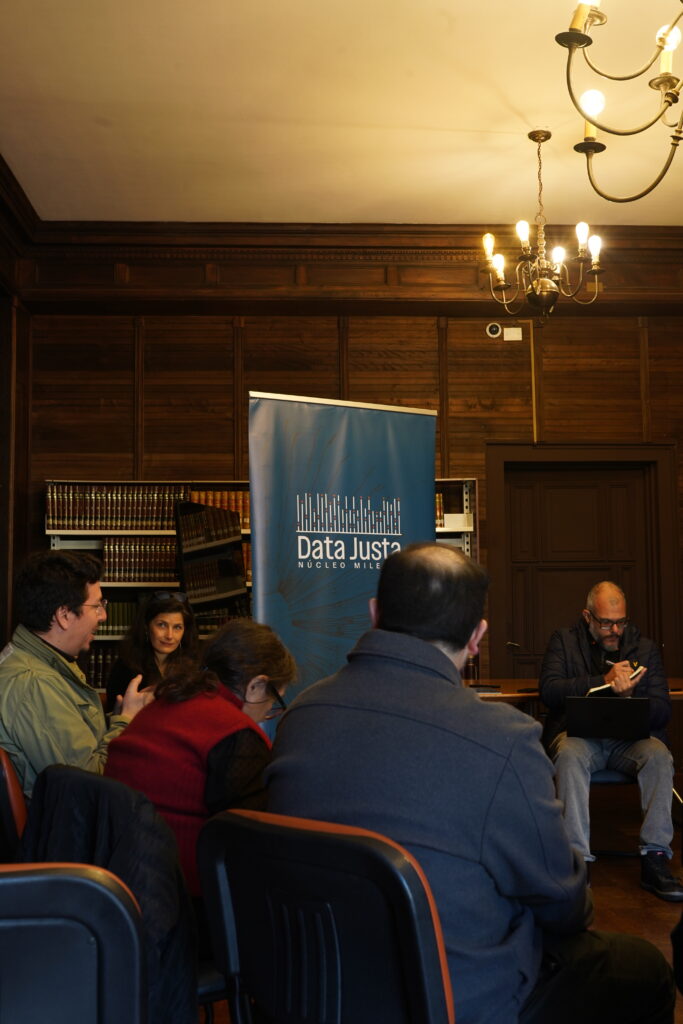
From a data justice perspective, he explained, it is not enough to ask whether a technology works, whether information is up to date, or whether a model is accurate. It is also necessary to examine which situations the data are able to represent, who participates in defining their categories, how potential errors are distributed, and what opportunities people have to challenge a decision.
“We can move from the question ‘What can this technology do?’ to a more political question: What kind of State are we building through it, and what kind of relationship with citizens are we institutionalizing?” Treré argued.
When a category follows a person
Data do not emerge spontaneously. Behind every database are decisions about what to record, how to classify it, how often information should be updated, and which situations should be left out. Institutions, budgets, technologies, providers, and working practices also play a role.
“Data are not a neutral snapshot of reality: they are a social construction,” Treré explained.
Something as commonplace as a person’s place of residence can introduce into an assessment a history of territorial segregation and unequal distribution of resources. Similarly, frequent contact with social services might be interpreted as an indicator of risk, when it may also reflect a need for support or a closer relationship with the State.
Administrative categories make it possible to organize information and guide responses, but they can also follow a person for years and influence how different institutions perceive them. This is why it is important to understand not only whether data are accurate, but also what they represent and what consequences they produce.
Gaps deserve equal attention. A person without a stable internet connection, a formal address, or the ability to complete a digital form may appear as an incomplete record. What the system presents as an individual anomaly may, in fact, reflect a broader inequality.
“Absence is also data. What is not measured disappears from institutional view,” Treré stated.
Recognizing these gaps does not mean that the solution is always to collect more information. Sometimes it may be necessary to revise a category, expand a right, strengthen professional support, or allocate more resources to the services responsible for addressing the problem.
Digitalizing without closing other doors
Digital transformation can save time, reduce the need for travel, and facilitate access to public services. But its effects change when the digital channel becomes the only point of entry.
A name that does not match a record, a fingerprint that a device fails to recognize, lack of connectivity, or a situation too complex to fit into a form can become barriers to accessing a service or benefit. Even when an alternative channel exists, it is worth asking whether people know about it, understand it, and can use it in a timely manner.
In these processes, the degree of discretion retained by those working within institutions to interpret each case also matters. Automation can support professional judgment, but it can also displace it if the system’s output comes to be treated as a definitive answer.
“Digital transformation is just when it expands the ways in which people can access the State, rather than turning digital competence into a silent condition for exercising citizenship,” Treré stated.
Data justice also invites us to follow the trajectory of information after it has been collected: where it is stored, who can access it, which records it is connected to, how long it is retained, and when it should be deleted.
Keeping everything increases the risks of data breaches and reuse for purposes other than those for which the information was originally collected. Deleting information without clear criteria can also eliminate evidence needed to investigate rights violations, reconstruct decisions, demand accountability, or preserve public memory.
Obsolescence poses an additional challenge. A file may remain stored and yet become unreadable because its format has changed, the provider has disappeared, or the platform used to open it no longer exists. “If the State cannot retrieve its own records, it cannot explain its decisions or guarantee rights either,” he warned.
This requires policies that distinguish between operational information, evidence for accountability, documentary heritage, and data for which there is no longer a legitimate basis for continued processing. It also requires institutional capacities to audit systems, migrate information, and change providers without losing services or institutional memory.
Incorporating other voices from the beginning
During the workshop, Treré also addressed the production of data by civil society organizations and communities. Citizen-generated records, maps, and other forms of information have helped make visible disappearances, environmental conflicts, housing problems, and territorial experiences that do not always appear in official systems.
“Data alone do not transform anything; they become meaningful when integrated into broader processes of organization and situated knowledge,” he noted.
These experiences broaden the idea of participation. It is not simply a matter of consulting people once a system has already been designed, but of recognizing them as producers of knowledge and involving them in defining problems, questions, and categories.
Before implementing or expanding a data system, Treré proposed that institutions ask themselves what public problem they are seeking to address and what evidence exists that the tool will be useful. He also called for consideration of who will receive its benefits, who will bear the consequences of its errors, and how a person will be able to understand, challenge, and correct a decision.
“The question is not so much how much data the State can collect, but what it should do with them, what it should not do, and who has a voice in deciding,” he concluded. From this perspective, “data justice is not an obstacle to digital transformation: it is a way of guiding and improving it.”
The workshop brought together public officials and professionals from different disciplines involved in assisting victims of femicide, human trafficking, and institutional violence. The event provided an opportunity to connect these reflections with the everyday challenges institutions face when producing, using, preserving, and sharing information.
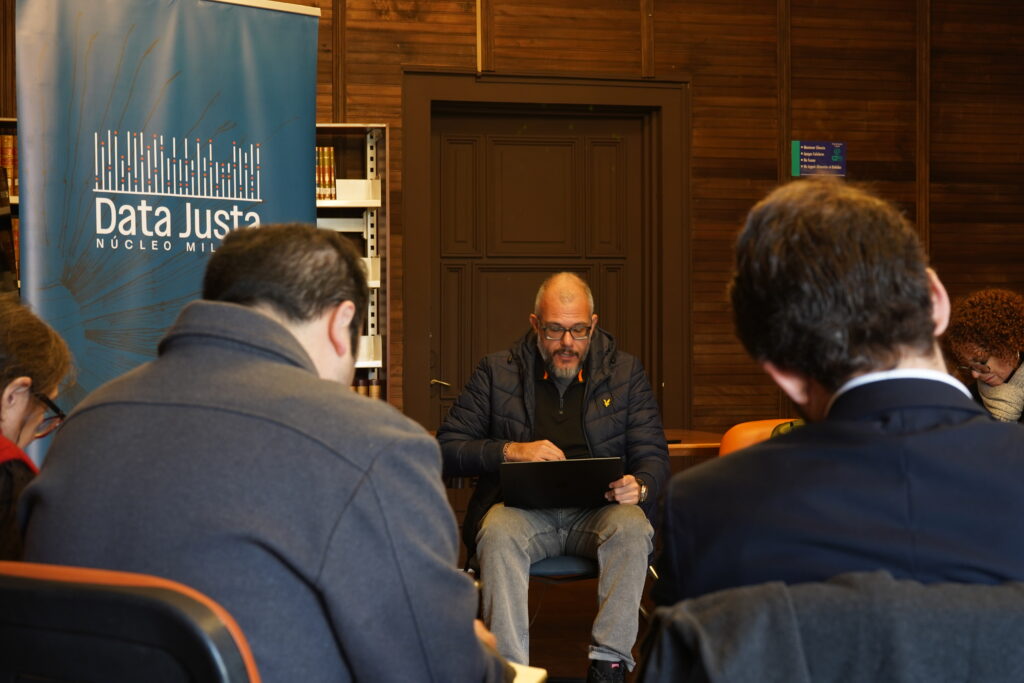
During his visit, Treré also participated in a working session with the Data Justa team on data trajectories, the visualizations developed by the Nucleus, and Visualista, the Nucleus’s visualization platform. The session provided an opportunity to examine how these tools can represent the complexity of institutional records, contribute to the project’s research questions, and foster reflection on State records through a data justice framework.