
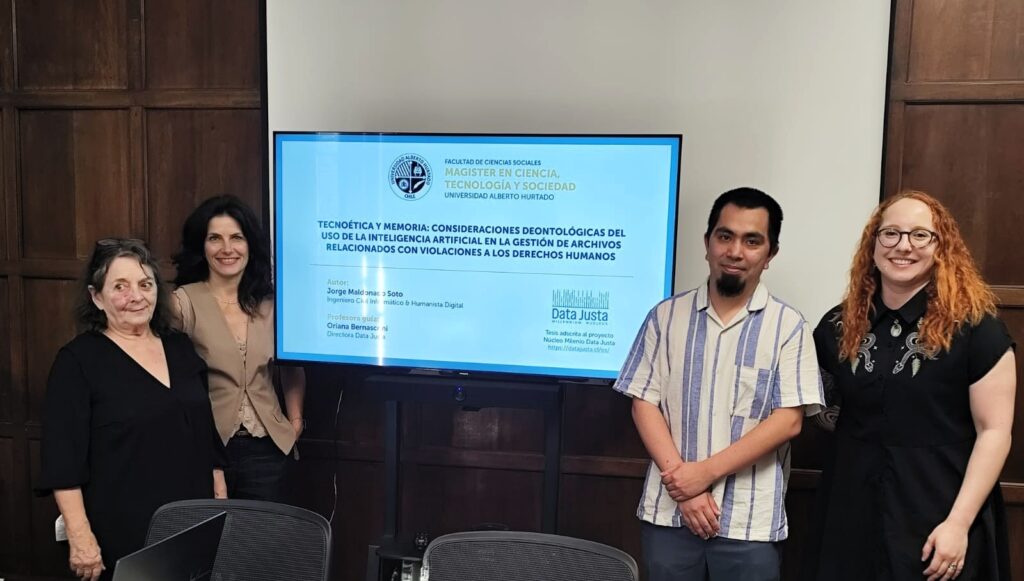
From Data Justa, we are pleased to highlight the successful defense of the master’s thesis of Jorge Maldonado Soto, a Computer Science Engineer specializing in digital humanities and a graduate thesis researcher on the team. He is the first Millennium Nucleus thesis student to obtain his degree, marking an important milestone for the project’s training area.
The research, titled “Technoethics and Memory: Deontological Considerations on the Use of Artificial Intelligence in the Management of Archives Related to Human Rights Violations,”is situated within the growing incorporation of artificial intelligence into archival management, particularly in archives linked to human rights violations, as in the case of Chile’s National Search Plan. This process has opened up opportunities for processing and analyzing large volumes of information, but it also raises significant ethical challenges. In this context, the thesis sought to identify the ethical considerations associated with the use of artificial intelligence in the management of human rights archives, with the aim of proposing ethical guidelines to orient its development in a responsible, fair, and transparent manner.
The study adopted a qualitative and critical approach, structured in three stages: the analysis of processes associated with the use of artificial intelligence in archival management; the review of governmental and intergovernmental ethical policies and recommendations; and the review of practical experiences involving the application of artificial intelligence in human rights archives. From a Science, Technology and Society (STS) perspective, the thesis understands the archive as a sociotechnical actor — that is, as a dynamic construction with political implications, shaped through the interaction between people, institutions, and technologies. It also incorporated conceptual frameworks linked to technoethics and data justice, emphasizing responsibility, transparency, and respect for human dignity in the use of these technologies.
To identify the main ethical principles guiding the responsible development and use of artificial intelligence, the research reviewed UNESCO’s Recommendation on the Ethics of Artificial Intelligence (2021), the European Union’s Artificial Intelligence Act (2024), and Chile’s National Artificial Intelligence Policy (2024). As case studies, it analyzed the experiences of Chile’s National Search Plan and Declass2024 in Chile; Cruzar in Uruguay; Desafío IA por la Identidad e IAbuelas in Argentina; the Arolsen Archives in Germany; and Themis IA of the Inter-American Court of Human Rights. This analysis made it possible to examine progress, good practices, and ethical tensions in the use of artificial intelligence in initiatives related to memory, truth, and justice.
Finally, the study’s findings propose a series of ethical orientations for the use of artificial intelligence in the management of archives related to human rights violations. It emphasizes the need to design projects with a prospective and people-centered approach, safeguarding historical memory, transparency, and the protection of sensitive data. It also highlights the importance of the active participation of human rights organizations, continuous supervision and evaluation, and accountability as central elements for ensuring the responsible and sustainable use of these technologies. In this sense, the thesis speaks directly to the objectives of the Data Justa project by problematizing the role of data systems and emerging technologies in processes of memory, truth, justice, and guarantees of non-repetition.
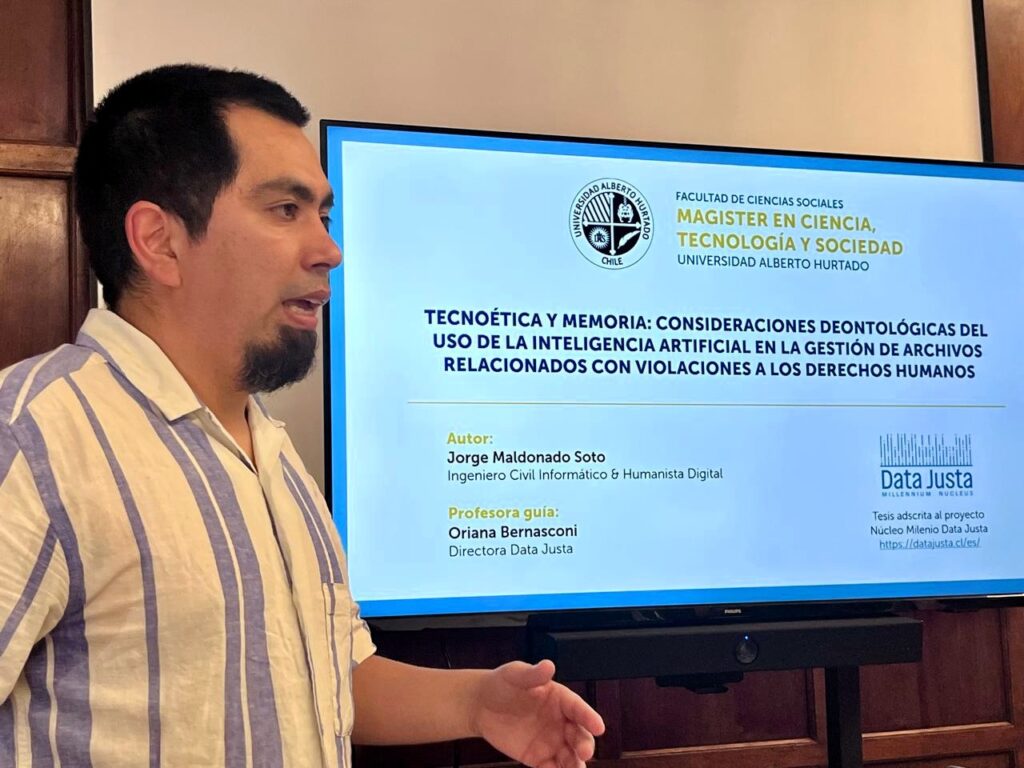
The thesis defense took place on Tuesday, December 9, in the Dean’s Council Room at Universidad Alberto Hurtado. The evaluation committee was composed of Oriana BernasconiDirector of the Data Justa project and thesis supervisor; Elizabeth Lira, faculty member at the School of Psychology of Universidad Alberto Hurtado and Deputy Director of the Data Justa project; and Gabriela Arriagada, faculty member at the Institute for Applied Ethics of Pontificia Universidad Católica de Chile and researcher at the National Center for Artificial Intelligence (CENIA). The evaluation committee approved the thesis, highlighting its contribution to the field.