
As part of the XIII Encuentro Red CTSheld at Universidad de Concepciónthe researchers Paola Moreno and Oriana Bernasconi presented the paper “Contar para existir: femicidio, feminicidio e infraestructuras de datos en la justicia de género en América Latina”, as part of the panel “Critical Analysis of Public Policies II.”
The presentation addressed a central question: How does the State respond when a woman is murdered, and what role do data play in that response? From a feminist and situated perspective, the presentation analyzed how the categories of femicide and feminicide, developed in Latin America, not only name gender-based violence, but also shape institutional infrastructures that determine which deaths are recorded, how they are counted, and which are left out of official systems.
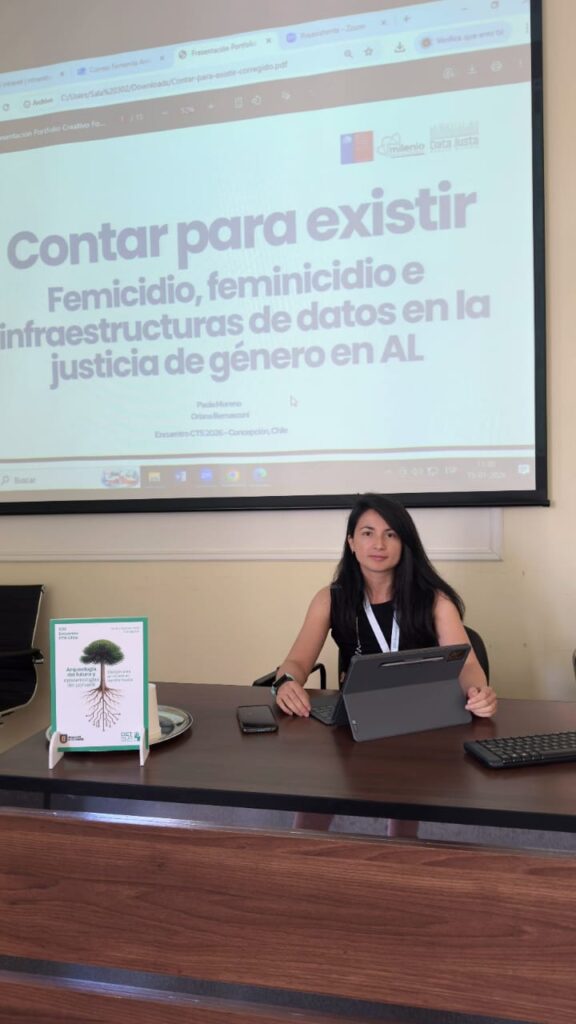
Based on a comparative analysis of legal frameworks across different countries in the region, the researchers showed that these laws operate as starting points for complex arrangements made up of legal categories, administrative records, and judicial procedures. Within this framework, they identified different ways of understanding femicide and feminicide — as a hate crime, an expression of unequal power relations, or the culmination of a continuum of violence — each with distinct implications for State responsibility and its obligations to prevent, punish, and repair.
The presentation also emphasized the data infrastructures as a key field of dispute in gender justice. Although States produce evidence, records, and statistics on femicide, these data do not always translate into institutional learning or transformations in public policy. In this sense, the presentation argued that what is not named or recorded remains outside the field of State action, directly affecting access to justice and the visibility of violence.
The participation of Data Justa is part of Data Justa’s commitment to contributing to critical debates on data, human rights, and gender, engaging with interdisciplinary academic communities and helping to reflect on how States produce, use — or fail to use — the information they generate in response to structural forms of violence.