
Ethnographer Maryam Ajdam proposes studying disappearance through silences, traces, and the ways in which absence becomes perceptible in places.
How can an absence be researched? How can a story be reconstructed when people, places, or even the words needed to tell it have disappeared?
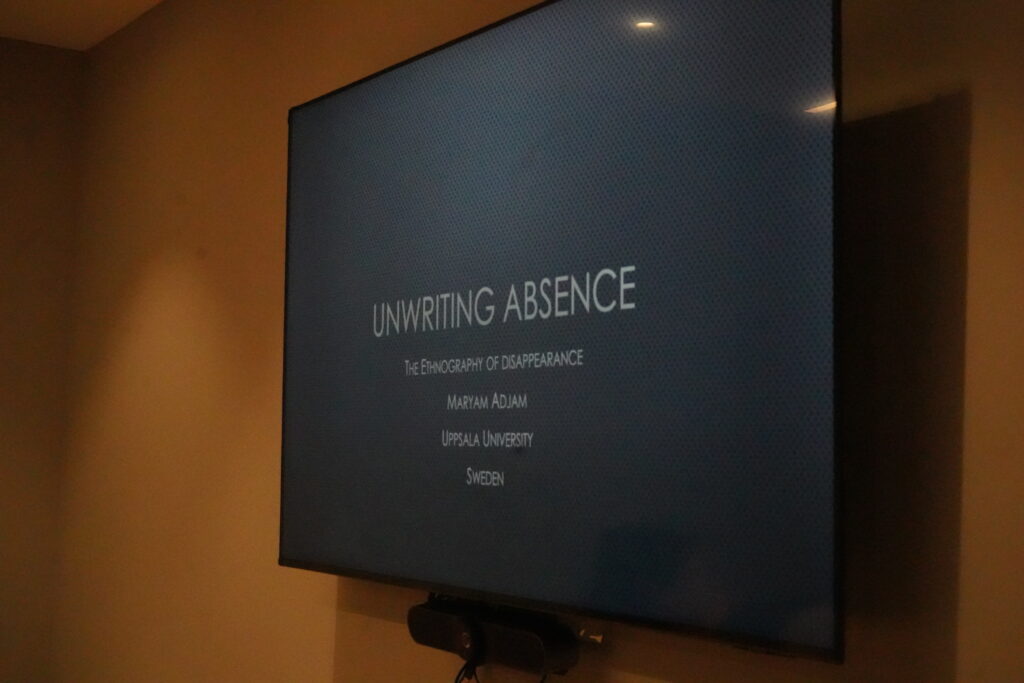
These questions guided the presentation by Maryam Ajdam, a researcher at Uppsala University, during the first session of the Research Methods for the Study of Violenceseries, organized by Data Justa and VioDemos.
Ajdam studies disappearance in contexts of political violence perpetrated or enabled by the State. Central to her approach is the idea that disappearance does not simply mean removing someone or something from public space. It can also render language ambiguous, alter how a place is understood, and make it more difficult to represent what is missing.
From this perspective, disappearance can affect people, but also territories, memories, and words. Its effect is a landscape that retains traces of harm, even though not everyone may be able to recognize them. A place may be legible to those who know its history while remaining silent to those who do not have access to it.
Listening to Silences
To approach these experiences, Ajdam proposes “listening with the bones.” The expression invites us to think of silence not as an absence of information, but as a space in which absence itself can become manifest.
Stories of disappearance rarely emerge as complete and orderly narratives. They often appear through fragments, gaps, uncertain memories, objects, routes, and sensations. Researching these experiences requires paying attention to what cannot be directly expressed in words.
This approach also poses a challenge for those researching violence: rather than immediately filling silences or forcing them into a closed narrative, researchers must learn to work with uncertainty and with the partial traces left by absence.
Moving through places to recognize their traces
One of the methodologies used by Ajdam is sensory itineraries. By moving through places marked by violence, her research examines how memories relate to sounds, objects, images, movements, and bodily sensations.
Places do not function merely as settings where certain events occurred. They also retain traces that can activate memories and make absence perceptible. Memory is thus constructed through temporal relationships between bodies, spaces, and materialities.
This method broadens the range of sources that can be used to study violence. In addition to testimonies and documents, it incorporates silences, sensations, and ways of moving through space. In doing so, it raises questions about what remains after a disappearance and how these traces contribute to the memory of those who are missing.
Methods for studying and communicating violence
Maryam Ajdam is an ethnographer and researcher at Uppsala University, Sweden. Her work is situated within memory studies and critical heritage studies, with a particular focus on commemorative practices related to experiences of war and state political violence. Her research combines ethnography, photography, literature, and poetic writing.
Upcoming sessions in the Series
Maryam Ajdam’s presentation, held on August 5 at the Institute for Applied Ethics at Pontificia Universidad Católica de Chile, inaugurated the Research Methods for the Study of Violence series, organized by Data Justa and VioDemos. Research Methods for the Study of Violenceseries, organized by Data Justa and VioDemos.
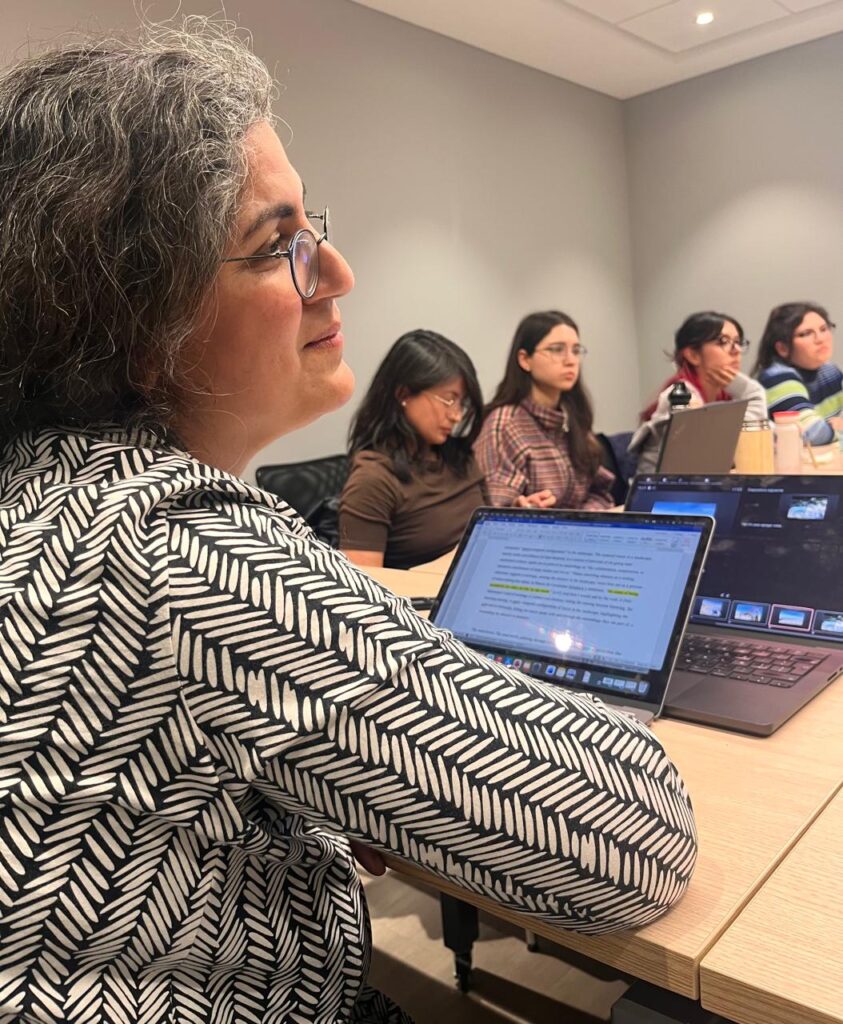
These sessions seek to create a space for exchange on different ways of researching violence and communicating research findings, drawing on the experiences and methodological approaches of international researchers. The series is aimed at graduate students, postdoctoral researchers, and members of Data Justa and VioDemos. Those interested in participating will soon be able to find registration information on the social media channels of both centers.