
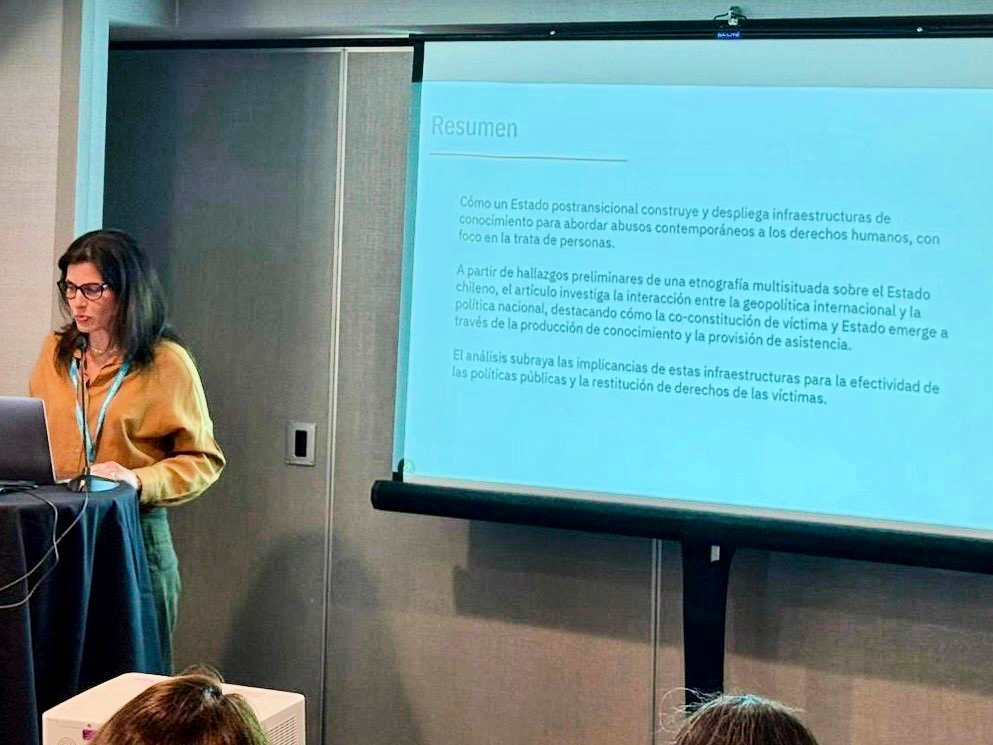
Between May 23 and 26, a new edition of the Congreso LASA2025In this context, Oriana Bernasconi, director of the Millennium Nucleus for Fair Data, along with prominent academics and experts, presented the panel «Making Science, Making Truth: Human Rights Infrastructures Beyond the State», this panel provided a space to explore how science and technology have been mobilized to construct the truth about human rights violations. It highlighted the collaboration between both state and non-state actors in producing knowledge about human rights violations, with the aim of contributing to processes of reparation and justice.
In recent years, science and technology have become central to the investigation of human rights crimes, as well as to reparations and justice efforts. From forensic identification to data collection and victim location, scientific infrastructures have emerged as a fundamental pillar of human rights governance. However, these efforts tell only part of the story of how science and technology are mobilized to reconstruct the truth of past and contemporary atrocities.
This panel addressed how scientific processes in human rights research can be not only a technical and scientific field, but also a field of political, ethical, and epistemological struggle. Through a transdisciplinary perspective, the following themes were discussed:
- The co-creation of new forensic technologies as a form of activism in Mexico.
- Restoring the scientific legitimacy of the Legal Medical Service in Chile, following a misidentification scandal.
- International cooperation, highlighting the role of German organizations in the transfer of forensic knowledge in Mexico.
- The influence of international policies and national political agendas on the knowledge infrastructures of contemporary human rights violations in Chile.
- Local innovations in the practice of forensic identification in Colombia, after the peace agreements.
The panel highlighted not only the technical and scientific dimension of human rights research, but also the importance of emotions, care, and community connections as fundamental elements in the production of knowledge in this field.
About the panel:
- Eden Medina (MIT) – Session Organizer
- Oriana Bernasconi (Pontificia Universidad Católica de Chile) – Chairwoman
- Jo-Marie Burt (George Mason University) – Commentator
Papers:
- Eden Medina (MIT) – How Do Scientific Organizations Regain Legitimacy in the Aftermath of Error and Scandal?
- Julia Alejandra Morales Fontanilla (Santa Clara University) – Warming Up a Cadaver’s Identity. Improvising Technoscience and the Everydayness of War in the Colombian Morgues
- Lindsay A. Smith (Arizona State University) – Technology Innovation, Forensic Activism, and Decolonial Science Practice in Human Rights: Co-Designing «La Varilla Electrónica»
- Vivette Garcia-Deister (Facultad de Ciencias UNAM) – Ordinary Technology and Extraordinary Policy: Fingerprint Scanners and International Cooperation Amidst Mexico’s Forensic Crisis
- Oriana Bernasconi (Pontificia Universidad Católica de Chile) – Contemporary Human Rights Violations and Post-Transitional States Human Rights Knowledge Infrastructures: Human Trafficking and Chilean State Geopolitical Legibility
Panel date: May 24, 2025, 12:00pm-01:30pm, local time in San Francisco, United States.
The paper presented by Oriana Bernasconi is part of the Millennium Nucleus Data Justa (N°NCS2024_069), funded by the Millennium Scientific Initiative of the National Agency of Science and Technology (Chile).
For more information about the Congress, visit: https://lasaweb.org/es/lasa2025/