
As part of two recent academic activities, Oriana Bernasconi and Andrés Tello, researchers at the Data Justa Millennium Nucleus, shared reflections on the ethical challenges that arise from the use of data in contexts of human rights violations. Their presentations opened up key questions about the production, circulation, and state management of data, as well as the social, political, and human effects of their use.
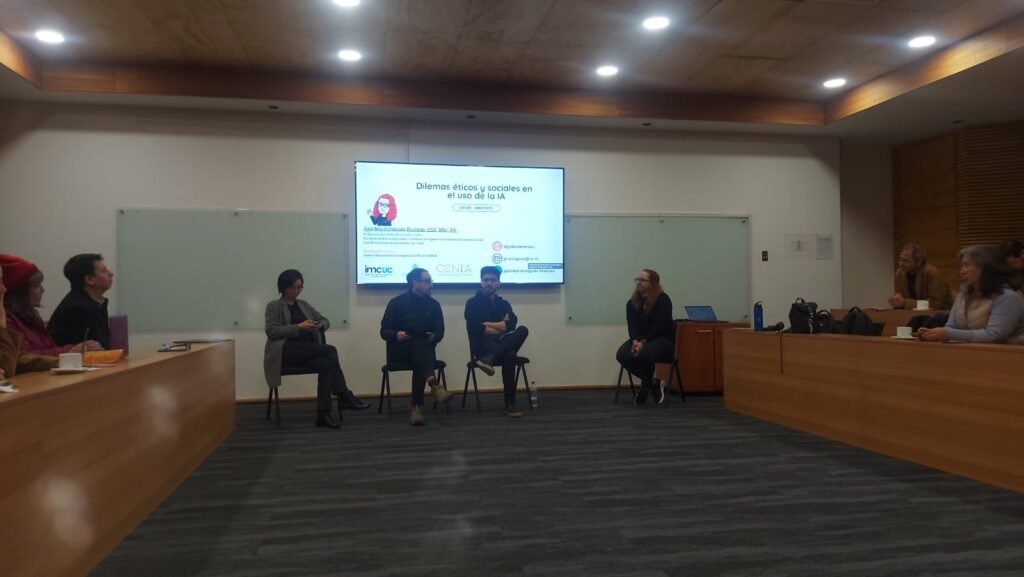
On June 9th, at the Colloquium “Dilemas éticos y sociales en el uso de la inteligencia artificial”Andrés Tello addressed the social impacts of artificial intelligence technologies from a critical perspective. In his presentation, he reflected on how artificial intelligence operates within a logic of data capitalization that can exacerbate structural inequalities. Through an analysis of the algorithmic production chain, Tello highlighted processes of labor precarization and data colonialism, demonstrating how certain technological practices reproduce extractive relationships with specific territories, bodies, and forms of knowledge. His presentation proposed considering the ethics of technological development not only in terms of what is automated, but also for whom and for what purposes.
For her part, on June 10, Oriana Bernasconi participated in the UC Applied Ethics Conference Series, with the presentation “El valor en la gestión estatal de víctimas de violaciones a los derechos humanos”. On this occasion, she focused her analysis on the Ethical aspects involved in the state's work managing victims of human trafficking. Based on the work carried out within the framework of Data Justa, Bernasconi identified some challenges that the State faces in registering this crime, including multidimensional victimization, distrust of institutions, and the high presence of migrants and children and adolescents among the victims.
During her presentation, she also addressed existing regulations on human trafficking in Chile, mentioning Law 21.057 on Videotaped Investigative Interviews as an important step forward in preventing secondary victimization of children and adolescents. She also emphasized the importance of ethics in case management, as well as the well-being of professional teams, highlighting experiences of self-care and principles such as solidarity, shared responsibility, and harm prevention.
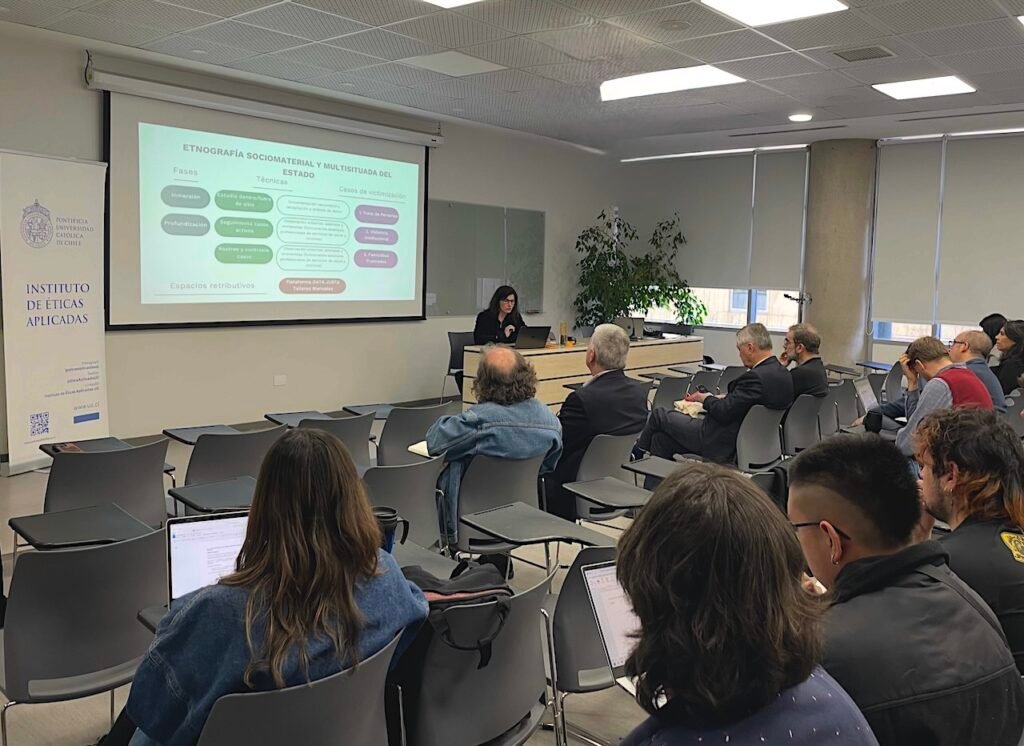
Her presentation concluded with an invitation to critically reflect on the limits and possibilities of state action, specifically: How can we envision state action that transforms assistance and reparations for victims into an opportunity to drive changes that eradicate the recurrence and magnitude of these atrocious acts? This challenge, as Oriana mentions, involves confronting the conditions and inequalities that underlie vulnerability, and rethinking information systems and impact indicators for public policies toward a more integrated and interdisciplinary system.
Both interventions contribute to Data Justa's work from different but complementary perspectives: on the one hand, they critique the underlying logics that govern contemporary technological development, and on the other, they address the ethical dilemmas of state action regarding victims of human rights violations. Together, they create a critical space for reflection on building more equitable, accountable, and transformative systems of knowledge and public action.